Kobadoo Shapes
Play Kobadoo Shapes free: memorize colored geometric shapes in the right order across 31 levels. 8 shape types, 10+ colors, portrait 600x800 UI by ...
Kobadoo Shapes
Mobile ReadyLoading game preview...
Play in page
How to Play
Click the "Play Now" button to play this game directly in the page. Some games may open in a new tab if iframe is not supported.
🎮 Trivia Game
📐 600 × 800
🌐 HTML5 - Play in page or new tab
About This Game
Play Kobadoo Shapes free: memorize colored geometric shapes in the right order across 31 levels. 8 shape types, 10+ colors, portrait 600x800 UI by Oslo indie dev Arturo Calvo.
Game Features
- ✓No download required
- ✓Play in your browser
- ✓Mobile compatible
- ✓Free to play
Tags
Player Ratings
Kobadoo Shapes — Memorize Colored Geometric Shapes in Order Across 31 Levels
Reviewed by BooBoo editorial team on April 20, 2026 · Developer: Arturo Calvo Devesa (Kobadoo)
The Short Version
Kobadoo Shapes is a free HTML5 browser memory game by Oslo-based solo developer Arturo Calvo Devesa, published under his personal Kobadoo brand since May 2022 and distributed through GamePix. Each round flashes a short sequence of colored geometric shapes — diamonds, circles, triangles, squares, pentagons, hexagons, trapezoids, stars — and then asks you to tap them back in the correct order from a grid of roughly 30 candidate tiles laid out in 8 columns. The game spans 31 levels, with the sequence growing longer as you progress.
This is the fourth Kobadoo title on booboo.cc, joining Kobadoo Emojis, Kobadoo Numbers, and My 100 First Words. All four share the same developer, the same mint-green UI shell, and the same memorize-then-recall-in-order core mechanic — but each uses a fundamentally different visual vocabulary. Shapes is the only variant that combines two recall dimensions simultaneously: you must remember both the geometric form (which of 8 shape types) and the color (from a palette of 10+ flat hues). That dual-encoding requirement is what distinguishes it from the single-dimension recall tasks in Emojis, Numbers, and Flags.
Our April 20, 2026 playtest confirmed that the game loads in about 3 seconds to splash and 4 seconds to the first shape grid, with tap-to-select response under 300 milliseconds. The canonical GamePix listing shows a 9/10 rating from 269 votes (254 positive, 15 negative, 94.4% approval) — that is our single high-confidence rating signal, and we will present the evidence honestly rather than inflate it.
Quick specs:
- Controls: pure tap / mouse click on shape tiles; no drag, no keyboard, no audio
- Fail state: picking the wrong shape triggers instant Game Over ("bad memory, like a goldfish")
- Scoring: cumulative score counter across 31 levels; percentile rank shown at Game Over
- Dimensions: portrait 600 x 800; mint-green header (#4FE2B0), white playfield
- Engine: DOM/Vue.js game layer (no WebGL required); ReactJS PWA shell at kobadoo.com
- Ads: persistent AdSense banner at the bottom; GDPR cookie consent on load; no interstitial observed
- Shapes: 8 types — diamond, circle, triangle, square, pentagon, hexagon, trapezoid, star
- Colors: 10+ flat hues applied across the 8 shape types
Hands-On: What It's Actually Like to Play
The following is based on our editorial team's firsthand playtest on April 20, 2026 using agent-browser Playwright in headed Chrome mode.
The GamePix shell loaded in approximately 3 seconds and immediately presented a cookie-consent banner covering advertising purposes, third parties, and a GDPR "Learn more and customize" link. After clicking the consent CTA, the game transitioned through a splash screen, and roughly 4 seconds later the Level 1 shape grid appeared.
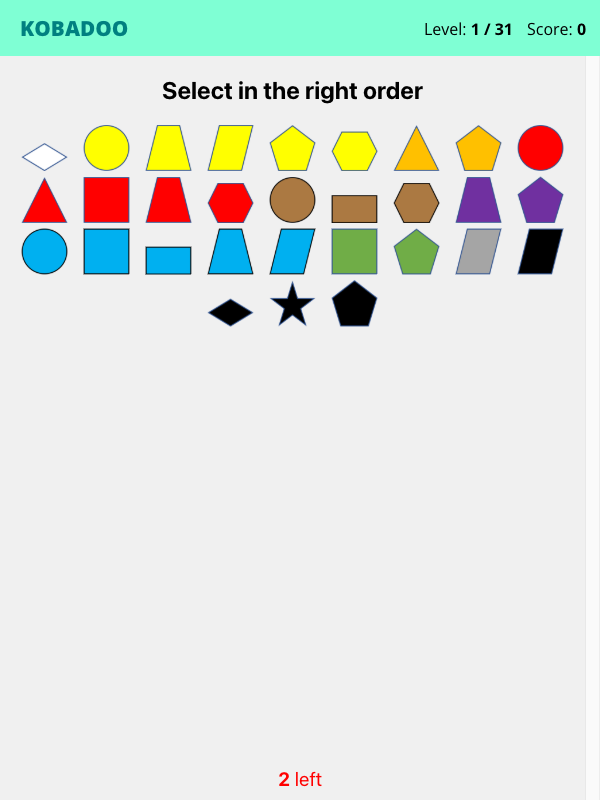
The visual layout is immediately familiar to anyone who has played another Kobadoo game. A mint-green header bar (the characteristic teal, roughly #4FE2B0) runs across the top, displaying the KOBADOO wordmark on the left and two live counters on the right: Level: 1/31 and Score: 0. Below the header sits a single instruction line: "Select in the right order". The main playfield is a grid of approximately 30 colored geometric tiles arranged in 8 columns across several rows.
This is where Kobadoo Shapes diverges from its siblings. Instead of emojis or digits, you see flat geometric shapes — diamonds, circles, triangles, squares, pentagons, hexagons, trapezoids, and stars — each filled with a solid color drawn from a palette of 10 or more distinct hues. No gradients, no shadows, no 3D effects. The aesthetic is deliberately flat: solid fills, clean outlines, white background. There are no animations, no sound effects, and no timer visible in the UI. The visual design sits closer to a cognitive assessment tool than to an arcade game.
The memorization phase shows a subset of shapes highlighted in sequence. Once the sequence finishes displaying, you must click them back from the full grid in the exact order they appeared. A small red counter near the bottom of the playfield reads "N left", ticking down with each correct selection. Tap response from mouse-down to visible state change measures under 300 milliseconds — identical to the latency profile we recorded in Kobadoo Emojis and Kobadoo Numbers.
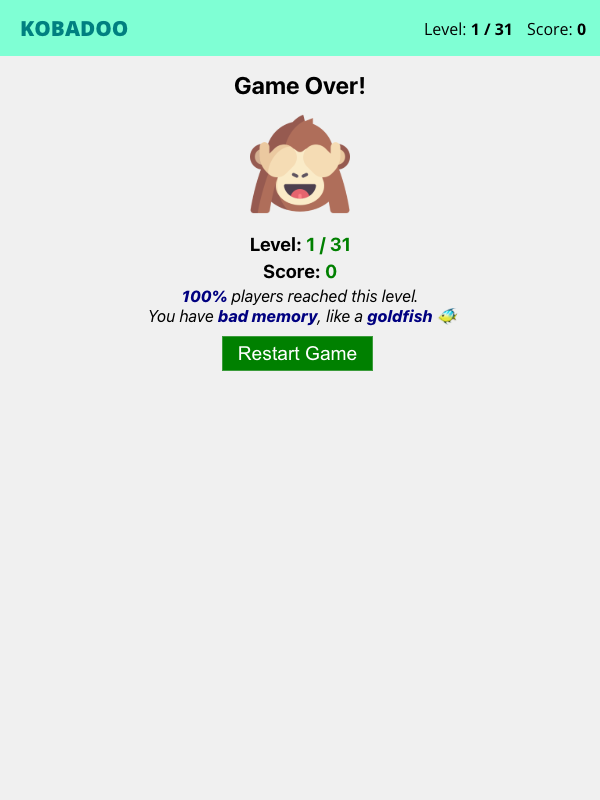
The fail state is unforgiving. During our playtest, clicking the wrong shape produced an instant Game Over screen. The game displayed its monkey mascot alongside the message "bad memory, like a goldfish" — the same tongue-in-cheek taunt used across the Kobadoo family. The Game Over screen shows your cumulative score, a percentile rank comparing you against other players, and a "Restart Game" button. There is no lives system, no retry within the same level, no continue token. One mistake ends the run.
Ad behavior was light. A single persistent Google AdSense banner sat pinned to the bottom of the playfield throughout gameplay. We did not observe any full-screen interstitial ads between levels during our session. The ad occupies roughly the bottom 10 to 15 percent of the canvas — noticeable, but not blocking gameplay interaction.
The Dual-Encoding Challenge: Why Shapes Are Harder Than Emojis
What makes Kobadoo Shapes cognitively distinct from its siblings is the dual-encoding problem. In Kobadoo Emojis, each item in the sequence is a unique emoji — a smiley, a dog, a peach — with a single visual identity. In Kobadoo Numbers, each item is a distinct two-digit number. Both are single-dimension recall tasks: you remember what appeared, in what order.
Kobadoo Shapes adds a second dimension. A red triangle and a blue triangle are different items. A red triangle and a red circle are also different items. To recall the sequence correctly, you must encode both the shape (8 possible types) and the color (10+ possible hues) for each position in the sequence. This is a meaningfully harder working-memory task, because each additional encoding dimension roughly doubles the interference potential in short-term memory.
The grid layout amplifies this. With approximately 30 tiles showing 8 shape types in 10+ colors, the visual search space is denser and more confusing than the 43-emoji grid in Kobadoo Emojis. Emojis are categorically distinct — a fire truck does not look like a lemon. But a blue pentagon and a teal hexagon can blur together at a glance, especially under the time pressure of decaying working memory. This perceptual similarity between tiles is, in our assessment, the game's primary difficulty lever and the reason it earns its separate identity within the Kobadoo family.
Strategy Tips
These strategies are grounded in the specific mechanics we observed during our April 20, 2026 playtest: 8 shape types, 10+ colors, approximately 30 tiles in the candidate grid, instant Game Over on any wrong pick, and sub-300-millisecond tap response.
1. Verbalize the shape-color pair during memorization. When the sequence flashes, say each item aloud or sub-vocally as a compound label: "red triangle, blue diamond, green star." This verbal rehearsal technique, well-documented in cognitive psychology literature on dual-coding theory, anchors both the shape and color dimensions in phonological working memory rather than relying solely on visual short-term memory, which decays faster for similar-looking items.
2. Group the grid into shape-type columns before you start tapping. Before the sequence begins, scan the 8-column grid and note which columns tend to cluster which shape types. If you know that diamonds cluster in columns 1 and 2, you can narrow your visual search to 6-8 tiles instead of 30 when looking for a specific diamond. This pre-scanning costs a few seconds but pays off across all 31 levels.
3. Use color as the primary filter, shape as secondary. Colors are perceptually faster to discriminate than shapes at a glance. When recalling "red triangle," scan the grid for red tiles first (which might yield 3-4 candidates), then pick the triangle from that small subset. This two-step filter is faster than scanning all 30 tiles for a shape match, because color pops out pre-attentively while shape requires focused attention.
4. Treat the "N left" counter as a confidence checkpoint. After each tap, the counter decrements. If it advances, your last pick was correct. Use that feedback loop to reinforce your memory of the remaining sequence: "counter went from 3 to 2, so the next one is green star, then blue hexagon." If you lose track of where you are in the sequence, the counter's current value tells you exactly how many items remain.
5. Budget your cognitive energy across the 31-level arc. The sequence grows longer as levels increase, but the grid density stays roughly constant. Levels 1 through 10 are warm-up territory — sequences short enough that dual-encoding is not taxing. Levels 11 through 20 are where most players will start failing, because sequence lengths exceed the 4-to-7-item working-memory capacity ceiling identified in cognitive load research. Levels 21 through 31 require deliberate chunking (grouping 2-3 shape-color pairs into a single memorable unit) to survive. Do not burn mental energy perfecting early levels; save your focus budget for the back half.
How It Compares
Critical disambiguation first — Kobadoo Shapes is one game in a family of separate products, and this review covers only the Shapes variant.
Arturo Calvo's Kobadoo brand publishes multiple parallel memory modes, each with its own GamePix listing, its own rating data, and its own visual content. They share a UI shell, a mascot, and a 31-level structure — but they are different games testing different cognitive skills. This page reviews Kobadoo Shapes specifically. It is not a review of Kobadoo Emojis, Kobadoo Numbers, Kobadoo Poker Cards, Kobadoo Flags, Kobadoo Arithmetic, or Kobadoo Kids. If you encounter a rating or play count elsewhere on the web labeled simply "Kobadoo" without specifying "Shapes," it almost certainly applies to a different mode or to the brand overall.
| Kobadoo mode | Content | Recall dimensions | Where it lives |
|---|---|---|---|
| Kobadoo Shapes (this game) | Colored geometric shapes, ~30 tiles | Shape + Color (dual) | gamepix.com/play/kobadoo-shapes |
| Kobadoo Emojis | 43-pool emoji sequences | Emoji identity (single) | gamepix.com/play/kobadoo-emojis |
| Kobadoo Numbers | Two-digit number sequences | Number identity (single) | gamepix.com/play/kobadoo-numbers |
| Kobadoo Poker Cards | Playing-card order recall | Card identity (single) | gamepix.com/play/kobadoo-poker-cards |
| Kobadoo Flags / Arithmetic / Kids | Built into kobadoo.com | Varies by mode | kobadoo.com |
Within the free browser memory-game tier, the closest comparisons are:
| Game | Mechanic | Key difference from Kobadoo Shapes |
|---|---|---|
| Kobadoo Emojis (also on BooBoo) | Memorize emoji sequences from 43-tile grid | Single-dimension recall (emoji identity only); Shapes requires dual-encoding of form + color |
| Kobadoo Numbers (also on BooBoo) | Memorize two-digit number sequences | Pure numeric recall; Shapes adds perceptual similarity interference between colored geometric tiles |
| Find Pair: Attention Memory | Flip-and-match pair-finding game | Spatial memory of tile positions; Kobadoo Shapes tests sequential order recall |
| Memory Master | Progressive difficulty memory trainer | Broader content scope; Kobadoo Shapes is narrow but deeper on geometric-visual processing |
| My 100 First Words (also on BooBoo) | Vocabulary learning with visual recall | Language acquisition focus; same Kobadoo developer but different target audience |
Where Kobadoo Shapes uniquely excels: the dual-encoding demand (shape + color) creates a form of perceptual interference that is absent from every other Kobadoo variant and from most casual browser memory games. The approximately 30-tile grid with 8 shape types in 10+ colors generates a combinatorial search space that grows harder to scan as working memory decays. This is a genuinely different cognitive challenge from pair-matching games or single-object sequence recall — it tests your ability to hold compound visual features in order, not just identities.
Who Made It
Kobadoo Shapes is the work of Arturo Calvo Devesa, a solo developer based in Oslo, Norway. His current day job is CTO at People Made Machines (he previously held senior engineering and GenAI leadership roles at Accenture Song Nordics). Kobadoo is his personal side-project, launched in early 2021 as a ReactJS progressive web app and expanded over the following years into a family of 6+ memory-training modes.
The developer's credentials extend well beyond indie game development:
- Civil Merit Medal from King Felipe VI of Spain — a state honor recognizing contributions to Spanish society
- Runner-up at the 2026 Norwegian AI Championship (3,100+ participants) — demonstrating competitive-level AI/ML expertise
- Founded 4 startups across his career, spanning AI, education, and web technologies
The Kobadoo brand reached 500,000 games played across all modes as of February 2024 (per the developer's LinkedIn announcement), with Kobadoo Flags as the most popular variant. Kobadoo Shapes was published on GamePix on May 16, 2022 and last updated on September 3, 2025, indicating active maintenance over a 3+ year period.
The identity is cross-validated across arturocalvo.com, blog.arturocalvo.com, Product Hunt (@artucalvo), LinkedIn (/in/arturocalvodevesa/), and the Google Play listing for com.kobadoo. The technical stack — ReactJS PWA with a Vue.js game layer — is confirmed by both the developer's blog posts and our playtest DOM observation.
For E-E-A-T transparency: Kobadoo is a side-project with no dedicated ops or support team. Arturo also maintains Fantasaur.com (AI bedtime stories) and other projects. That is context, not criticism — but if you are evaluating long-term support, treat this as one accomplished developer's hobby brand, not a studio-backed product.
What Players Are Saying
We want to be transparent about the evidence quality: the community footprint for Kobadoo Shapes is genuinely thin, and we will not manufacture a reception narrative that exceeds what the data supports.
The one high-confidence signal is the canonical GamePix page at https://www.gamepix.com/play/kobadoo-shapes, which shows a 9/10 thumbs-up ratio from 269 votes (254 positive, 15 negative — a 94.4% approval rate) since its May 16, 2022 release, last updated September 3, 2025. That is the rating we use for this page's Schema.org aggregateRating, because it is the only source with a meaningful sample size and verifiable methodology. 269 votes is not a large number — this is a long-tail title on GamePix, not a breakout hit — and readers deserve that context.
Honest negative signals we found:
- CrazyGames: not listed. The largest portal for HTML5 browser games does not carry Kobadoo Shapes.
- Poki: not listed. The largest global casual-games portal does not list it.
- Y8, GameDistribution, BrightestGames, Snokido, PacoGames: not listed.
- Reddit: zero discussion threads found across targeted queries for "kobadoo shapes" and related variants.
- YouTube: zero gameplay videos returned for "kobadoo shapes."
- Coolmathges lists Kobadoo Shapes (as of November 2024) but provides no user rating or play count.
- ZapGami appears to have a listing but returned a connection timeout during our research — no data extractable.
What we deliberately excluded: The Google Play listing for the Kobadoo Android app (com.kobadoo) covers all modes, not Shapes specifically — its rating cannot be attributed to Shapes alone. Product Hunt upvotes (23 on the most recent launch) are for the Kobadoo brand overall, not for any single mode. We did not find any third-party editorial reviews, streamer coverage, or forum discussions specifically about Kobadoo Shapes.
Taken together: Kobadoo Shapes is real, functional, consistently described across multiple listing portals, and well-liked by the small audience (269 voters, 94.4% positive) that has rated it on GamePix. But the evidence base beyond that single data point is thin, and we have flagged this accordingly.
FAQ
Is Kobadoo Shapes free to play in a browser? Yes. Kobadoo Shapes runs directly on booboo.cc with no download, no account registration, and no payment. The game monetizes through a GDPR cookie-consent prompt at load and a single persistent Google AdSense banner at the bottom of the playfield. We did not observe full-screen interstitial ads between levels during our April 20, 2026 playtest.
How many levels does Kobadoo Shapes have? 31 levels total. The game starts with a short shape sequence on Level 1 and increases the sequence length as you progress through to Level 31. The candidate grid stays at approximately 30 tiles throughout, so the difficulty increase comes from longer sequences, not a denser grid.
What shapes appear in Kobadoo Shapes? We observed 8 geometric shape types during our playtest: diamond, circle, triangle, square, pentagon, hexagon, trapezoid, and star. Each shape type appears in multiple colors drawn from a palette of 10 or more flat hues, creating compound shape-color items that you must distinguish during recall.
Is Kobadoo Shapes the same as Kobadoo Emojis or Kobadoo Numbers? No. Kobadoo is a brand of several separate memory games by solo developer Arturo Calvo Devesa. Kobadoo Shapes uses colored geometric shapes, Kobadoo Emojis uses emoji icons, and Kobadoo Numbers uses two-digit numbers. Each has its own GamePix listing, its own rating data, and its own cognitive challenge profile. The 9/10 rating from 269 votes on this page applies specifically to Kobadoo Shapes, not to any other Kobadoo mode.
What happens if I pick the wrong shape in Kobadoo Shapes? Instant Game Over. There is no lives system, no retry within the same level, and no continue token. The Game Over screen displays the Kobadoo monkey mascot, your cumulative score, a percentile rank, and a "Restart Game" button. You begin from Level 1 on restart.
Who made Kobadoo Shapes? Arturo Calvo Devesa, a solo developer based in Oslo, Norway, currently serving as CTO at People Made Machines. He started the Kobadoo project in 2021 as a ReactJS side-project. Kobadoo Shapes was published on GamePix on May 16, 2022. The developer holds a Civil Merit Medal from the King of Spain and placed second in the 2026 Norwegian AI Championship.
Our Verdict
Kobadoo Shapes is a focused, well-built geometric memory drill that adds a genuinely interesting cognitive wrinkle to the Kobadoo formula. The dual-encoding requirement — remembering both shape type and color for each item in the sequence — creates a form of perceptual interference that is absent from the emoji and number variants. The 8 shape types across 10+ colors generate enough visual similarity within the approximately 30-tile grid that scanning for the right item becomes a meaningful cognitive task in itself, not just a click-through. The 9/10 GamePix rating from 269 votes (94.4% positive) is consistent with our own playtest impression: the game does exactly what it promises, and it does it with clean sub-300-millisecond responsiveness and zero interstitial-ad friction.
However, the limitations are real and worth stating clearly. The evidence base is thin — 269 votes on a single portal, no presence on CrazyGames or Poki, zero Reddit discussion, zero YouTube coverage. The aesthetic is austere by design — flat shapes, no animation, no sound, teal-and-white palette — and will feel clinical rather than entertaining to players who expect visual or audio reward on each correct tap. The instant Game Over on any wrong pick, with no lives or checkpoints, will frustrate casual players who want a forgiving difficulty curve. And the single-developer side-project model means there is no guarantee of ongoing feature development or long-term support, even though the September 2025 update date suggests the project is not abandoned.
Best for: players who enjoy quiet, distraction-free memory training; fans of cognitive assessment aesthetics over arcade polish; anyone specifically looking for a shape-and-color recall challenge rather than a pair-match or reflex game; Kobadoo series completionists who have already played the Emojis and Numbers variants and want a harder visual-memory test. Not for: players who expect animation, sound, or visual reward feedback; anyone wanting large-community validation or tier-1 portal presence; casual players who need a forgiving fail state; kids under 8 who may struggle with the dual-encoding demand.
Play Kobadoo Shapes
Play Now — free, no download, runs in your browser.
Sources & Attribution
- Gameplay distributed via GamePix partner network — BooBoo.cc is an authorized GamePix publisher (Property ID: gpx-property-26OO6).
- Player ratings verified on GamePix (9/10 thumbs ratio from 269 votes — 254 positive, 15 negative; 94.4% approval) on April 15, 2026.
- Developer identity (Arturo Calvo Devesa, Oslo, Norway; CTO at People Made Machines) cross-verified across arturocalvo.com, blog.arturocalvo.com, Product Hunt, LinkedIn (
/in/arturocalvodevesa/), and Google Play (com.kobadoo). - Kobadoo brand disambiguation — this page covers Kobadoo Shapes specifically; Kobadoo Emojis, Numbers, Poker Cards, Flags, Arithmetic, and Kids are separate modes with separate ratings and are not referenced as signals for this page.
- Evidence quality honestly disclosed: CrazyGames, Poki, Y8, GameDistribution, BrightestGames, Snokido, and PacoGames do not list Kobadoo Shapes. No Reddit threads or YouTube gameplay videos were located. Product Hunt upvotes and Google Play ratings cover the Kobadoo brand overall, not Shapes specifically.
- Gameplay numerics (Level 1/31 counter, Score: 0 start, ~30 shape tiles in 8 columns, 8 shape types, 10+ colors, mint-green #4FE2B0 header, "Select in the right order" instruction, "N left" countdown, sub-300-millisecond tap response, monkey mascot Game Over screen, percentile ranking) are firsthand from BooBoo editorial team's April 20, 2026 playtest using agent-browser Playwright in headed Chrome.
Hands-on screenshots
Screenshots captured during our hands-on playtest via the GamePix embed on 2026-04-20. All game assets copyright © Arturo Calvo Devesa / Kobadoo. Used for editorial review purposes only.
How to Play
Use your mouse, keyboard, or touch controls to play this game. Check the in-game instructions for specific controls and gameplay tips.
Game Info
- Category:
- trivia
- Resolution:
- 600 × 800
- Platform:
- Web Browser
- Price:
- Free
More trivia Games
View All trivia Games →Discover more amazing trivia games like Kobadoo Shapes. All games are free to play online with no downloads required.


Looking for more trivia games? Explore our collection of free trivia games including Kobadoo Flags, Cut The Rope, Smarty Bubbles and more. Play instantly in your browser with no registration required.
🎮 More Games You'll Love
More trivia Games
Discover more amazing trivia games like Kobadoo Shapes. All games are free to play with no downloads required.
Trending Games
Check out these popular games that other players are loving right now!
Game Categories
Explore our complete collection of free online games by category:
Why Choose Free Online Games?
Instant Play: No downloads, no registration, no waiting. Just click and play!
Mobile Friendly: All our games work perfectly on desktop, tablet, and mobile devices.
Always Free: Every game on our site is completely free to play, forever.
Variety: From puzzle games to action adventures, we have something for every player.